
A car doesn’t have to be a rusted-out wreck to end up at the scrap stage. Plenty of vehicles we pick up across Toronto and the GTA still start, still drive, and still look presentable in the driveway. What pushes an owner toward scrapping usually comes down to money and practicality rather than the car being physically finished.
If you’re wondering whether your own vehicle fits the pattern, it helps to understand what these cars actually have in common.
Age and Mileage Are the Starting Point
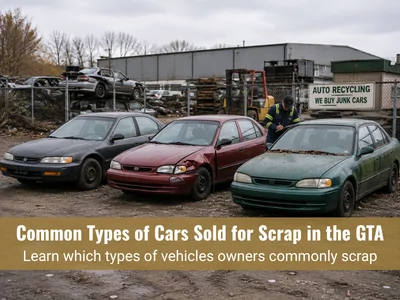
Older, high-mileage vehicles are common candidates for scrap, and the reason is simple economics. Once a car crosses a certain age and odometer reading, parts start wearing out in clusters. You fix the alternator, then the suspension needs work, then the exhaust goes. Each repair on its own might be reasonable, but the running total begins to outweigh what the car is worth.
At that point, spending $2,000 on a vehicle worth $1,200 stops making sense. The badge doesn’t change this math. A high-mileage Honda or Toyota reaches the same tipping point as a Ford or Dodge, just sometimes a little later.
Cars That No Longer Run
A non-running car is one of the most common reasons owners reach out to us. Whether it’s a dead engine, a failed transmission, or an electrical fault nobody can trace affordably, a vehicle that won’t move becomes a problem sitting in your driveway or taking up a parking spot.
Diagnosing and repairing these issues often costs more than the car will ever return. Selling privately is nearly impossible too, since few buyers want a vehicle they have to tow home. Scrapping turns a dead weight into cash, and because we offer free towing, the fact that it won’t start isn’t your problem to solve.
Accident-Damaged and Structurally Compromised Vehicles
Collision damage is another frequent path to scrap. When repair estimates climb past the car’s value, or an insurer writes the vehicle off, fixing it rarely adds up. Frame and structural damage in particular can make a car unsafe to put back on the road even after cosmetic repairs.
These vehicles still hold real value, though. Usable panels, engines, and components get recovered, and the metal itself is recycled rather than wasted.
Major Mechanical Failure
Some cars are otherwise fine but hit a single expensive wall. A blown engine or a transmission replacement can cost several thousand dollars, and on an older vehicle that figure simply can’t be justified. Owners in this situation often decide the smarter move is to recover the scrap value and put it toward something newer.
Vehicles That Have Simply Been Sitting
Not every scrap car has a dramatic story. A lot of them just sat.
- A second vehicle nobody drives anymore
- A car left behind after someone upgraded
- A project that never got finished
- An inherited vehicle no one needs
The longer a car sits unused, the more it deteriorates. Tires flatten, seals dry out, rust spreads, and rodents move in. Insurance and registration keep costing money while the vehicle quietly loses whatever value it had left. For many owners across the GTA, clearing it out is more about reclaiming space and stopping the slow bleed than the money itself.
You Don’t Need a Wreck to Scrap It
This trips up a lot of people. There’s a common assumption that scrap yards only want vehicles that have been destroyed, so owners hang onto running cars that no longer make financial sense to keep.
In reality, a car can be worth scrapping while still driving. If the resale value is low, the repairs are mounting, or you just can’t find a private buyer for an old vehicle, scrapping is often the cleaner option. Condition matters far more than whether the car technically still turns over.
Does Make and Model Matter?
Less than you’d think. Older vehicles from just about every common brand end up scrapped, including Honda, Toyota, Ford, Chevrolet, Dodge and Hyundai. What determines whether a specific car reaches that stage is its age, its condition, and the cost of keeping it roadworthy, not the name on the grille.
Is Scrapping the Right Move for You?
It comes down to weighing a few practical things:
- Are repair bills getting hard to justify against the car’s value?
- Does the vehicle still run, and if not, what would fixing it cost?
- Is there any real resale demand for it?
- Is it costing you in insurance, storage, or maintenance while sitting?
If most of those point the same direction, scrapping is worth a serious look. If your car is newer and only needs a minor fix, it may still be worth repairing or selling privately. The point is to look at the whole picture rather than assuming an old or damaged car is automatically done.
If your vehicle fits what you’ve read here, we can take it off your hands quickly. With over 25 years serving Toronto and the surrounding GTA, we offer same-day pickup, free towing, and fair cash for cars in any condition, any make and model. Give us a call at 416-414-2977 and we’ll handle the rest.