
Picture two neighbours on the same street in Toronto. Both own the same year and model. Both cars stopped running months ago. Both owners call around for scrap quotes on the same afternoon. One walks away with a noticeably higher offer, and the other is left wondering what went wrong.
This happens far more often than most people expect, and it rarely means anyone was shortchanged. Two vehicles can look like twins in a driveway and still be worth different amounts the moment a buyer looks closer.
Why Appearance Alone Rarely Tells the Full Story
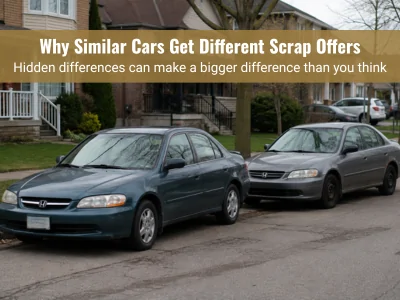
From the curb, an older sedan is an older sedan. Same shape, same paint fading in the same spots, same tired tires. But a scrap vehicle isn’t valued the way a used car is. Nobody’s judging how it looks. What matters is what’s actually inside it, what’s still attached, and what condition those parts are in.
Two cars with matching badges can have completely different histories. One might have been maintained until the day it quit. The other could have sat outside for three winters, been stripped for a few parts, or lost components to a past collision. None of that is obvious at a glance, yet all of it changes the math.
What Buyers Actually Assess Before Quoting
An experienced scrap car buyer doesn’t zero in on a single detail and decide from there. The offer comes from reading the whole vehicle at once. The overall weight and how much recoverable metal it holds sits alongside the condition of major components like the engine and transmission, whether the catalytic converter is still intact, and what’s already been removed.
All of that gets weighed against where the scrap metal market sits that day and how much demand exists for that particular make and model. No single one of those settles the number. It’s the full picture that does, which is exactly why two cars that seem identical can land in different places.
After inspecting a lot of vehicles over the years, we’ve learned that the cars people assume are worth the same rarely are. Two that look identical in a driveway often tell very different stories once you check what’s actually present and what’s been quietly taken. That firsthand experience is what lets us spot the details most owners never think to look at, and it’s usually those details that explain a gap in offers.
What People Often Compare, and What Actually Matters?
When owners compare offers, they tend to focus on the things they notice day to day: mileage, paint condition, a few scratches, the odd dent. Those feel important because they’re visible.
For a scrap buyer, they barely move the needle. What carries the weight is the vehicle’s recoverable value, how complete it is, which components can be reused, and where the market sits at that moment. A clean-looking car missing key parts can be worth less than a scuffed one that’s whole. It’s a different way of measuring the same vehicle.
A Realistic Comparison
Here’s how small, hidden differences add up between two cars that look the same on paper:
| Assessment Area | Car A | Car B | Why It Matters |
|---|---|---|---|
| Catalytic converter | Intact | Removed | One of the higher-value components; its absence noticeably lowers an offer |
| Engine and transmission | Complete | Partly stripped | Missing major parts reduces what can be recovered or reused |
| Wheels and tires | All four steel | Two missing | Fewer usable parts and less recoverable material |
| Time left outdoors | A few months | Two-plus years | Longer exposure often means more deterioration and lost components |
| Overall recoverable metal | Higher | Reduced | Weight and salvageable material directly shape the final number |
Neither owner did anything wrong. Car A simply has more left to recover, so it earns more. Car B lost value through things that happened long before the quote, most of which aren’t visible from across the yard.
Why Comparing Your Quote to Someone Else’s Misleads You
When you hold your offer up against a neighbour’s, you’re assuming the two vehicles are equal. They almost never are. Across Toronto and the surrounding GTA, it’s common for owners to hold their offer up against a friend’s or a neighbour’s vehicle, but those two cars are rarely close enough to compare fairly. A difference in one component, a few missing parts, or even the day the quote was given can separate two otherwise matching cars.
Scrap metal pricing also moves. An offer from last month and an offer today can differ purely because the market shifted, not because one car was better. This is why every vehicle deserves to be assessed on its own. The car parked next door tells you very little about yours.
Why Two Buyers Can Offer Different Prices for the Same Vehicle
Even the exact same car can draw different offers from two legitimate buyers, and that doesn’t mean either one is being unfair. Operating costs vary from one business to the next. So do recycling partners, the demand a buyer has for specific reusable parts, and the way each one handles pickup and processing.
Those differences are normal, which is why getting a quote directly on your own vehicle is worth more than assuming every buyer will land in the same place.
The Reliable Way to Learn What Your Vehicle Is Worth
The only accurate number comes from having your specific vehicle evaluated as it stands right now, with its own parts, its own condition, and the current market factored in.
That’s where we come in. At Cash for Scrap Car GTA, we assess each vehicle on its own and give you an honest quote based on what your car actually is, not what a similar one down the street happened to be. We buy any make and model, in any condition, running or not, and back it with free towing and same-day pickup where available across Toronto and the surrounding GTA.
Call us at 416-414-2977 to find out what your own vehicle is worth, with no guesswork and no pressure.